Bailey CO Horse Properties: A Smart Buyer’s Guide
May 28, 2026
May 28, 2026
If you are dreaming about room for horses, bigger views, and more privacy, Bailey can be a compelling place to start your search. But buying acreage here is not as simple as finding a few fenced acres and calling it a horse property. You need to understand zoning, water, septic, access, and how mountain conditions affect daily life so you can buy with confidence. Let’s dive in.
Bailey offers a mountain setting in northeastern Park County at about 7,700 feet, and that setting shapes both lifestyle and property decisions. Park County reports average annual precipitation of 15.7 inches, average annual snowfall of 80 inches, January temperatures around 9°F to 40°F, and July temperatures around 44°F to 80°F.
For many buyers, the appeal is simple: more land and a true foothills-to-mountain lifestyle. Active land listings also suggest Bailey often offers more acreage for the money than closer-in foothills communities like Conifer and Evergreen, although parcel quality can vary significantly from one property to the next.
Bailey is also far enough from Denver that your day-to-day experience feels different. A typical route snapshot puts Bailey about 43.9 miles and roughly 57 minutes from Denver under normal conditions, but Park County notes that winter can begin in late September, last into May, and snow is possible in every month.
This is one of the biggest things buyers need to know. A parcel with open land may look perfect for horses, but acreage alone does not confirm that your intended use is allowed.
Park County has several zoning districts, including Agricultural, Agricultural Small Lot, Residential, Mountain Residential, Residential Estate, Residential Ranch, Mixed Use, and others. The county also warns that its public zoning map is for general information only, not the current official zoning record, so you should verify zoning with Development Services before you close.
That matters because horse-related uses can be treated differently depending on the exact zone and the specific use. A private riding arena, stable, barn, grazing setup, or boarding arrangement may be permitted, conditional, or prohibited depending on the parcel.
In Park County, 35 acres is an important threshold for acreage buyers. Tracts created on or after June 1, 1972 and smaller than 35 acres cannot be rezoned into the Agricultural district, while some older sub-35-acre tracts may be legally non-conforming.
That does not mean smaller parcels are unusable. It does mean you should not assume a 5-acre or 10-acre property can function the same way as a larger agricultural parcel, especially if your plans include grazing, leasing pasture, or building horse-related improvements.
If you are comparing multiple properties, this threshold can help you quickly sort which parcels may better match your long-term goals. It is one of the first details worth checking during your due diligence.
If you plan to keep horses on residentially zoned land, Park County has specific standards that can affect how many animals you can have. In the residential district, equines and some other livestock may be kept on lots over one acre at one animal per 20,000 square feet of open space that does not contain a structure, with a maximum of four animals.
The county also allows up to six domesticated animals on lots under 10 acres and up to ten domesticated animals on lots 10 acres or larger. Because these rules depend on lot size, open space, and structures already on the site, the practical capacity of a parcel may be smaller than you expect at first glance.
This is why a property tour should include more than the home and views. You want to look closely at the layout of the land, where structures sit, and how much truly usable open area remains.
A horse property can feel spacious until you map out the setbacks. Park County requires corrals, stalls, and barns to be at least 50 feet from any dwelling and 100 feet from any water well or watercourse.
Those distances can reduce the area available for fencing, turnout, shelter placement, and daily circulation. If a parcel has a creek, a well in the middle of the lot, or an existing home placed near the flattest ground, your usable horse setup area may be much smaller than the total acreage suggests.
The county also requires regular removal of organic waste, so buyers should think about both placement and ongoing management. A property that looks easy to use still needs to function well in practice.
Fencing rules are another detail worth reviewing before you buy. Park County allows common permanent fence materials and prohibits razor wire except for detention and emergency facilities.
Aboveground electric fencing is generally allowed in most districts except residential, commercial, and rural center mixed-use, but residential lots with large livestock may use aboveground electric fencing. Park County also defines a lawful fence for livestock disputes as a well-constructed three-barbed-wire fence with substantial posts spaced about 20 feet apart.
If your plan includes leasing pasture or commercial grazing, ask more questions. Park County states that commercial grazing or leasing of acreage under 35 acres is not allowed unless there is a valid grazing association and a lease signed by all parties.
On rural property in Bailey, water deserves its own checklist. Park County says private wells supply most homes and businesses in the county, and it also notes that private wells are not regulated.
The county’s Bailey-area PFAS information reported elevated PFAS in 8 of 14 private wells tested in Burland Ranchettes after a 2022 complaint. That does not mean every well in Bailey has the same issue, but it does reinforce why buyers should review water information carefully and not treat the well as a background item.
Colorado’s Division of Water Resources notes that a well permit file can show allowable uses of the well, the original application, and available construction or pump records. For horse property buyers, that is especially important because the well’s allowed uses may affect how the property fits your plans.
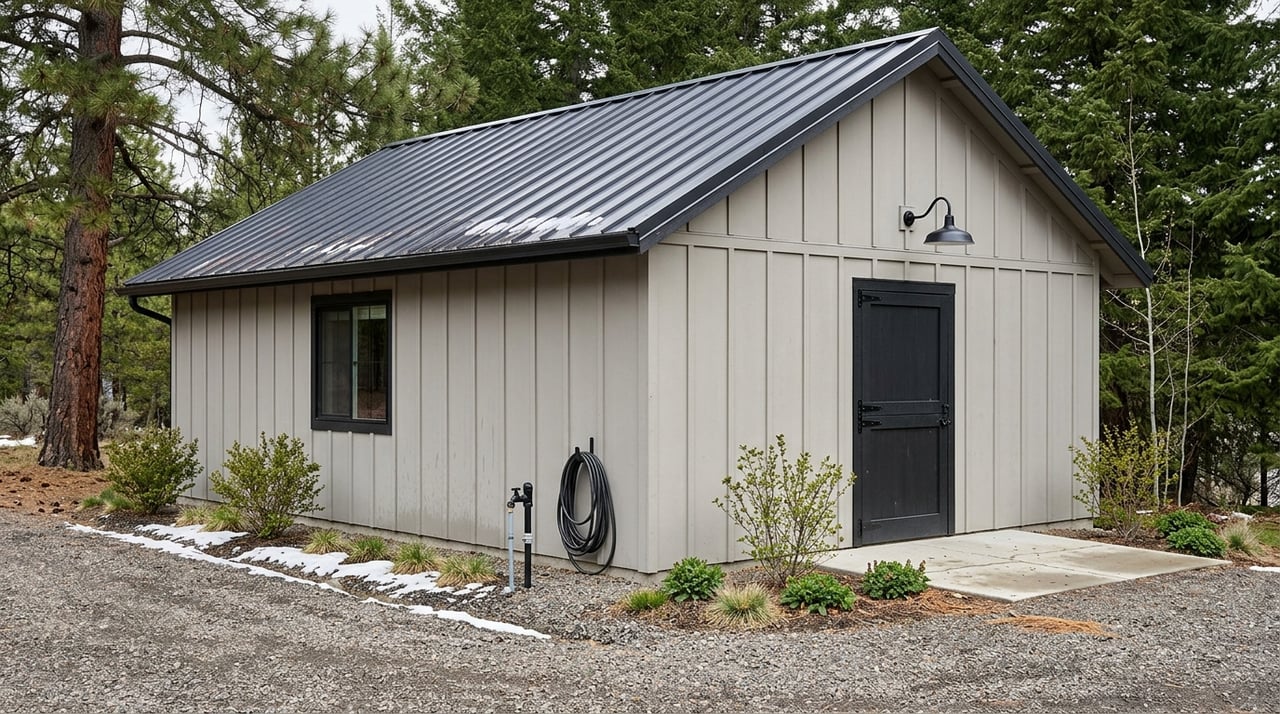
Many acreage buyers picture adding a barn, shop, loafing shed, or guest space in the future. Before you count on that, confirm what the parcel can actually support.
Park County states that accessory structures are not permitted on lots smaller than 35 acres without a residence. In some districts, accessory structures are also restricted by parcel size, so the parcel’s zoning and current improvements matter.
For new construction, the county says new structures may not be occupied before final inspection and a Certificate of Occupancy. If your purchase decision depends on future improvements, it is wise to evaluate those requirements early rather than after closing.
Septic is one of the most important practical issues on mountain acreage. Park County’s transfer-of-title checklist shows that a sale may involve a septic permit application, septic inspection report, and fee.
The county’s transfer inspection report looks at prior backups, last pump date, tank condition, proper vegetation, surfacing effluent, ponding, and whether any system components are subject to compaction from a structure or corral. On horse properties, this matters because corrals, equipment traffic, and drainfields can end up competing for the same space.
If a system is undocumented, Park County requires a plot map showing the septic tank, leach field, well, all existing and proposed structures, setback distances, utility lines, and any watercourses or wetlands. That kind of mapping can change how usable a parcel really is for horses and outbuildings.
Access is easy to underestimate until the weather changes. Park County notes that some county roads are not maintained by the county, and development does not obligate the county to take on road maintenance.
That means you should understand who maintains the road, how the driveway performs in winter, and what access is like for trailers, hay delivery, or service vehicles. Park County also recommends 4WD or AWD in all seasons and emergency supplies year-round.
In a mountain market, access is part of the property. It affects convenience, safety, and how smoothly the property works for everyday use.
For buyers focused on land, Bailey can offer a meaningful value advantage. A recent listing snapshot showed Bailey land examples such as 1.04 acres for $39,000, 14.81 acres for $235,000, and 35.04 acres for $425,000.
Comparable snapshots in Conifer showed examples like 0.96 acres for $98,000, 2.09 acres for $190,000, 5.05 acres for $275,000, and 35 acres for $595,000. In Evergreen, examples included 0.57 acres for $199,000, 1.65 acres for $269,000, and 5.28 acres for $895,000.
These are not formal market medians, but they do suggest a proximity premium in closer-in foothills communities. If your priority is maximizing acreage and you are comfortable with Bailey’s mountain conditions and commute realities, the value equation may be attractive.
Before you move forward on an acreage or horse property, make sure you verify the basics:
Mountain acreage purchases involve more moving parts than many in-town transactions. In Bailey, a property can look ideal online and still have important limitations tied to zoning, water, septic, setbacks, or access.
That is why local, property-specific guidance matters. When you understand the land as well as the house, you put yourself in a much stronger position to choose a property that fits both your lifestyle and your long-term plans.
If you are exploring Bailey acreage or horse properties and want clear, experienced guidance on the details that matter most, connect with Freadhoff Home Group for a thoughtful, high-touch approach to your foothills property search.
Stay up to date on the latest real estate trends.